tiistai 15. toukokuuta 2018

Design Sketching: Animal Skulls


Edit: 6 pages of studies as of October 18. This post got quite a bit more traction than expected. I almost left it at 5 pages and casually posted on my facebook wall not expecting anything but it was shared in some groups. All the more reason to do the last one.

Referenced from natural history museum photos (own) and web images.

keskiviikko 28. maaliskuuta 2018

Design sketching: rocks


Rock sketches, inspired after fzd training program, term 1, wacom tablet, ipad pro+ apple pencil and zebra airfit lts ball point pen, compiled on A3 pages with industrial design style lettering and notes with design elements

maanantai 8. lokakuuta 2012

Tumblr Era 2012-2017

http://hsuhonen.tumblr.com/


So I blogged at Tumblr during 2012-2017 (major part of the university years which I started 2011) but never really got into the culture there as it was mostly about reblogging . Blogspot/Blogger is  still among the Big 5 Social networks so lets reactivate this.

maanantai 1. lokakuuta 2012

Drawing study

Conté Carbone on A4 paper. After Ingres' "Monsieur Leblanc". Good training for the hand-eye coordination as Ingres is one of the greatest draughtsmen in world of art, The Master of Line. Innovation is based on solid foundation (Old Masters) plus study of nature plus one's own personality. Just as the pianists play Bach over and over again so should visual artists learn from the giants of art.

lauantai 22. syyskuuta 2012

Ingres copy: finished!

Mastercopy after J.-A.-D. Ingres' The Valpincon Bather (La Grande Baigneuse 1804) oil on canvas 81x120 cm. Indirect painting method (earth red imprimatura, grisaille underpainting, 5-7 glazes and scumbling finish).

 I read somewhere (James Gurney's instructional book Imaginatice Realism) that mastercopying is a traditional practice, romantically considered a transcendence rite in which the student absorbs the previous great master's skills and spirit and analyses the masterpiece's composition, value control, figurative structure, anatomy knowledge, craftsmanship, technique, palette use, drawing, texture portrayal and tries to feel the same emotion the painter must have felt while painting the subject. I essence, meditating on the beauty and intelligence of the work. Therefore it is important to pick only the classic works by the finest figurative painters in history since even the greatest painters sometimes produced mediocre work and copying mediocre works only enhance mediocrity so it must be avoided.

The Valpincon Bather is considered the greatest nude painting of the 19th century, one of the definitive figure paintings in entire art history alongside Velazquez's Rokeby Venus. Valpincon Bather is Ingres' calmest painting as his other paintings of the female figure were quite wild, the scholar Gerald Ackerman commented even "perverse" (in Gerômé: Life and Works). Ingres' paintings are some of the most meticulous and finished to the highest degree in art history. This finishing and simplified classicising is what I wanted to learn from Ingres as well.

After summer break, back in Rovaniemi, I immediately began finishing this master copy, as documented in the blog post on late spring. I bought a pair of 4000 kelvin cool light bulbs for better lighting and painted from Friday August 31 till tuesday September 4 late night, detail after detail, zooming the reference image from computer screen. The deadline was on Friday, September 7, and the work was almost dry then. The teacher simply commented that this is "a stunning display of patience."

It could be the camera distortion but the right shoulder seems just a bit too wide, and the curtains still need some fine tuning.

By the way, I also finished the self-portrait.

sunnuntai 26. elokuuta 2012

Late summer studies and pocket sketches


 I read a book about the American Golden age of illustration and made master study of Charles Dana Gibson's iconic pen-and-ink drawing. A fraction of a millimeter makes a difference in such a delicate profile.


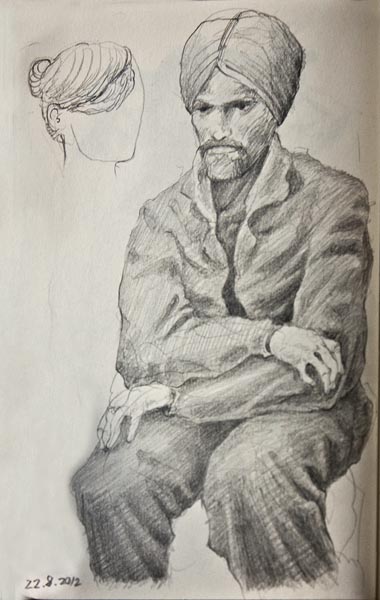
My summer job is over. I used every chance to draw from life when I could. These pocket sketchbooks were really handy. Drawing from life is like doing push-ups for the mind. I used the Reilly method to capture gesture from moving figure and then  relied on memory more or less.

torstai 16. elokuuta 2012

Open air sketching

 
Gas station at Järvenpää. Watercolor on sketchbook.


Watercolor on sketchbook. My brother and I went open air sketching at Ainola, the home of the national composer Jean Sibelius. The importance of observational drawing and painting from nature cannot be emphasized enough.


Thumbnail sketches at Itäkeskus,  Kellokoski, Jokela and Purola. A bit rough but it's all about the experience, keeping the skills up and recording color scemes for possible later assignments.

tiistai 7. elokuuta 2012

sunnuntai 15. heinäkuuta 2012

Digital painting WIP (updated 2)


Edit 2: The stage after rendering, detailing and fine tuning. I used a reference to achieve fluorescent light feel. There's also a slight desaturation filter. The shiny bag is still pretty sketchy,  and the face could be less stiff, I tried to avoid making it over worked, not too much air brush. I may add some skin pores and cloth texture for credibility to see if that helps.


I was sketching while returning from work via commuter train. I painted a preparatory value study of the sketch with Art Rage 2. Finished with Painter 11.

torstai 12. heinäkuuta 2012

Practicing


I once sculpted a clay study based on a figure. The statue is rather clumsy but still useful for observing light and shadow. I decided to practice my anatomy knowledge combined with the clay statue for value study and then color study with blue-gray guache ébauche and pastel on top.

Cat anatomy studies. One has to know what's inside to avoid making shallow drawings.

keskiviikko 11. heinäkuuta 2012

Field sketching

Kids at local mall. At Pekka Halonen academy we were encouraged to go to sketch at malls and other public places every now and then as drawing moving people enhances the ability to draw from both observation and memory.

Landscape paintings may not be interesting as works of art, but the process of trying to capture the colors to scientific accuracy is what makes it challenging and compelling. It helps to understand how light and color function in nature.